
BETA SAÚDE
Iterated logarithm
Texto da Wikipédia (en), licença CC BY-SA. O BETARUBI mostra o verbete inteiro nesta página — a leitura não continua fora do site.


In computer science, the iterated logarithm of , written log* (usually read "log star"), is the number of times the logarithm function must be iteratively applied before the result is less than or equal to .[1] The simplest formal definition is the result of this recurrence relation:



In computer science, lg* is often used to indicate the binary iterated logarithm, which iterates the binary logarithm (with base ) instead of the natural logarithm (with base e). Mathematically, the iterated logarithm is well defined for any base greater than , not only for base and base e. The "super-logarithm" function is "essentially equivalent" to the base iterated logarithm (although differing in minor details of rounding) and forms an inverse to the operation of tetration.[2]




Analysis of algorithms
The iterated logarithm is useful in analysis of algorithms and computational complexity, appearing in the time and space complexity bounds of some algorithms such as:
- Finding the Delaunay triangulation of a set of points knowing the Euclidean minimum spanning tree: randomized O(n log* n) time.[3]
- Fürer's algorithm for integer multiplication: O(n log n 2O(lg* n)).
- Finding an approximate maximum (element at least as large as the median): lg* n − 1 ± 3 parallel operations.[4]
- Richard Cole and Uzi Vishkin's distributed algorithm for 3-coloring an n-cycle: O(log* n) synchronous communication rounds.[5]
The iterated logarithm grows at an extremely slow rate, much slower than the logarithm itself, or repeats of it. This is because the tetration grows much faster than iterated exponential:
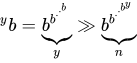
the inverse grows much slower: .

For all values of n relevant to counting the running times of algorithms implemented in practice (i.e., n ≤ 265536, which is far more than the estimated number of atoms in the known universe), the iterated logarithm with base 2 has a value no more than 5.
| x | lg* x |
|---|---|
| (−∞, 1] | 0 |
| (1, 2] | 1 |
| (2, 4] | 2 |
| (4, 16] | 3 |
| (16, 65536] | 4 |
| (65536, 265536] | 5 |
Higher bases give smaller iterated logarithms.
Other applications
The iterated logarithm is closely related to the generalized logarithm function used in symmetric level-index arithmetic. The additive persistence of a number, the number of times someone must replace the number by the sum of its digits before reaching its digital root, is .

In computational complexity theory, Santhanam[6] shows that the computational resources DTIME — computation time for a deterministic Turing machine — and NTIME — computation time for a non-deterministic Turing machine — are distinct up to

Gijswijt's sequence is known to be bounded above by . (The lower bound is , since every natural number has positive natural density in this sequence.)[7]

See also
- Inverse Ackermann function, an even more slowly growing function also used in computational complexity theory
References
- ↑ Cormen, Thomas H.; Leiserson, Charles E.; Rivest, Ronald L.; Stein, Clifford (2009) [1990]. "The iterated logarithm function, in Section 3.2: Standard notations and common functions". Introduction to Algorithms (3rd ed.). MIT Press and McGraw-Hill. pp. 58–59. ISBN 0-262-03384-4.
- ↑ Furuya, Isamu; Kida, Takuya (2019). "Compaction of Church numerals". Algorithms. 12 (8) 159: 159. doi:10.3390/a12080159. hdl:2115/75613. MR 3998658.
- ↑ O(n\\log^\\ast n)</math> algorithms for difficult <math>\\Omega(n)</math> problems"},"s2cid":{"wt":"60203"},"arxiv":{"wt":"cs/9810007"},"url":{"wt":"https://inria.hal.science/file/index/docid/167206/filename/hal.pdf"}},"i":0}}]}'/>Devillers, Olivier (March 1992). "Randomization yields simple algorithms for difficult problems" (PDF). International Journal of Computational Geometry & Applications. 2 (1): 97–111. arXiv:cs/9810007. doi:10.1142/S021819599200007X. MR 1159844. S2CID 60203.
- ↑ Alon, Noga; Azar, Yossi (April 1989). "Finding an approximate maximum" (PDF). SIAM Journal on Computing. 18 (2): 258–267. doi:10.1137/0218017. MR 0986665.
- ↑ Cole, Richard; Vishkin, Uzi (July 1986). "Deterministic coin tossing with applications to optimal parallel list ranking" (PDF). Information and Control. 70 (1): 32–53. doi:10.1016/S0019-9958(86)80023-7. MR 0853994.
- ↑ Santhanam, Rahul (2001). "On separators, segregators and time versus space" (PDF). Proceedings of the 16th Annual IEEE Conference on Computational Complexity, Chicago, Illinois, USA, June 18-21, 2001. IEEE Computer Society. pp. 286–294. doi:10.1109/CCC.2001.933895. ISBN 0-7695-1053-1.
- ↑ van de Pol, Levi (2022). "The first occurrence of a number in Gijswijt's sequence". arXiv:2209.04657 [math.CO].


