Texto da Wikipédia (en), licença CC BY-SA. O BETARUBI mostra o verbete inteiro nesta página — a leitura não continua fora do site.
Measurability theorem
In mathematics, the Hahn decomposition theorem, named after the Austrian mathematician Hans Hahn, states that for any measurable space  and any signed measure
  defined on the
  -algebra
  , there exist two -measurable sets,
  and
and  , of
, of  such that:
 and
and  .
.- For every
 such that
  , one has
  , i.e., is a positive set for .
- For every such that
 , one has
  , i.e., is a negative set for .
Moreover, this decomposition is essentially unique, meaning that for any other pair  of -measurable subsets of fulfilling the three conditions above, the symmetric differences
  and
and  are -null sets in the strong sense that every -measurable subset of them has zero measure. The pair
  is then called a Hahn decomposition of the signed measure .
Jordan measure decomposition
A consequence of the Hahn decomposition theorem is the Jordan decomposition theorem, which states that every signed measure defined on has a unique decomposition into the difference 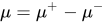 of two positive measures,
  and
and  , at least one of which is finite, such that
  for every -measurable subset and
  for every -measurable subset , for any Hahn decomposition of . We call and the positive and negative part of , respectively. The pair
  is called a Jordan decomposition (or sometimes Hahn–Jordan decomposition) of . The two measures can be defined as

for every and any Hahn decomposition of .
Note that the Jordan decomposition is unique, while the Hahn decomposition is only essentially unique.
The Jordan decomposition has the following corollary: Given a Jordan decomposition of a finite signed measure , one has

for any  in . Furthermore, if
 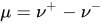 for a pair
  of finite non-negative measures on , then

The last expression means that the Jordan decomposition is the minimal decomposition of into the difference of non-negative measures. This is the minimality property of the Jordan decomposition.
Proof of the Jordan decomposition: For an elementary proof of the existence, uniqueness, and minimality of the Jordan measure decomposition see Fischer (2012).
Proof of the Hahn decomposition theorem
Preparation: Assume that does not take the value  (otherwise decompose according to
  ). As mentioned above, a negative set is a set
  such that
  for every -measurable subset
  .
.
Claim: Suppose that  satisfies
  . Then there is a negative set
  such that
 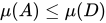 .
.
Proof of the claim: Define  . Inductively assume for
  that
that  has been constructed. Let

denote the supremum of  over all the -measurable subsets
  of
of  . This supremum might a priori be infinite. As the empty set
  is a possible candidate for in the definition of
  , and as
  , we have
  . By the definition of , there then exists a -measurable subset
  satisfying
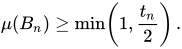
Set  to finish the induction step. Finally, define
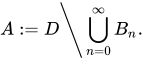
As the sets  are disjoint subsets of
  , it follows from the sigma additivity of the signed measure that

This shows that . Assume  were not a negative set. This means that there would exist a -measurable subset that satisfies
  . Then
  for every , so the series on the right would have to diverge to
  , implying that
  , which is a contradiction, since . Therefore, must be a negative set.
Construction of the decomposition: Set  . Inductively, given
  , define

as the infimum of  over all the -measurable subsets of
  . This infimum might a priori be . As is a possible candidate for in the definition of
  , and as , we have
  . Hence, there exists a -measurable subset
 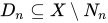 such that

By the claim above, there is a negative set  such that
  . Set
. Set  to finish the induction step. Finally, define
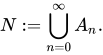
As the sets  are disjoint, we have for every -measurable subset
  that
that
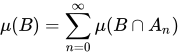
by the sigma additivity of . In particular, this shows that is a negative set. Next, define  . If were not a positive set, there would exist a -measurable subset
  with
with  . Then
  for all and[clarification needed]

which is not allowed for . Therefore, is a positive set.
Proof of the uniqueness statement:
Suppose that  is another Hahn decomposition of . Then
  is a positive set and also a negative set. Therefore, every measurable subset of it has measure zero. The same applies to
  . As
. As

this completes the proof. Q.E.D.
References
- Billingsley, Patrick (1995). Probability and Measure -- Third Edition. Wiley Series in Probability and Mathematical Statistics. New York: John Wiley & Sons. ISBN 0-471-00710-2.
- Fischer, Tom (2012). "Existence, uniqueness, and minimality of the Jordan measure decomposition". arXiv:1206.5449 [math.ST].
