
BETA SAÚDE
Glossary of functional analysis
Texto da Wikipédia (en), licença CC BY-SA. O BETARUBI mostra o verbete inteiro nesta página — a leitura não continua fora do site.
This is a glossary for the terminology in a mathematical field of functional analysis.
Throughout the article, unless stated otherwise, the base field of a vector space is the field of real numbers or that of complex numbers. Algebras are not assumed to be unital.
See also: List of Banach spaces, glossary of real and complex analysis.
*
- *
- *-homomorphism between involutive Banach algebras is an algebra homomorphism preserving *.
A
\\mathbb{R}^{\\mathbb{N}}</math>."}},"i":4}},"\n\n",{"template":{"target":{"wt":"term","href":"./Template:Term"},"params":{"1":{"wt":"Alaoglu"}},"i":5}},"\n",{"template":{"target":{"wt":"defn","href":"./Template:Defn"},"params":{"1":{"wt":"[[Alaoglu's theorem]] states that the closed unit ball in a normed space is compact in the [[weak-* topology]]."}},"i":6}},"\n\n",{"template":{"target":{"wt":"term","href":"./Template:Term"},"params":{"1":{"wt":"adjoint"}},"i":7}},"\n",{"template":{"target":{"wt":"defn","href":"./Template:Defn"},"params":{"1":{"wt":"The [[adjoint operator|adjoint]] of a bounded linear operator <math>T: H_1 \\to H_2</math> between Hilbert spaces is the bounded linear operator <math>T^* : H_2 \\to H_1</math> such that <math>\\langle Tx, y \\rangle = \\langle x, T^* y \\rangle</math> for each <math>x \\in H_1, y \\in H_2</math>."}},"i":8}},"\n\n",{"template":{"target":{"wt":"term","href":"./Template:Term"},"params":{"1":{"wt":"approximate identity"}},"i":9}},"\n",{"template":{"target":{"wt":"defn","href":"./Template:Defn"},"params":{"1":{"wt":"In a not-necessarily-unital Banach algebra, an [[approximate identity]] is a sequence or a net <math>\\{ u_i \\}</math> of elements such that <math>u_i x \\to x, x u_i \\to x</math> as <math>i \\to \\infty</math> for each ''x'' in the algebra."}},"i":10}},"\n\n",{"template":{"target":{"wt":"term","href":"./Template:Term"},"params":{"1":{"wt":"approximation property"}},"i":11}},"\n",{"template":{"target":{"wt":"defn","href":"./Template:Defn"},"params":{"1":{"wt":"A Banach space is said to have the [[approximation property]] if every compact operator is a limit of finite-rank operators."}},"i":12}},"\n\n",{"template":{"target":{"wt":"glossary end","href":"./Template:Glossary_end"},"params":{},"i":13}}]}' id="mwFA"/>- abelian
- Synonymous with "commutative"; e.g., an abelian Banach algebra means a commutative Banach algebra.
- Anderson–Kadec
- The Anderson–Kadec theorem says a separable infinite-dimensional Fréchet space is isomorphic to .
- Alaoglu
- Alaoglu's theorem states that the closed unit ball in a normed space is compact in the weak-* topology.
- adjoint
- The adjoint of a bounded linear operator between Hilbert spaces is the bounded linear operator such that for each .
- approximate identity
- In a not-necessarily-unital Banach algebra, an approximate identity is a sequence or a net of elements such that as for each x in the algebra.
- approximation property
- A Banach space is said to have the approximation property if every compact operator is a limit of finite-rank operators.








B
U_i</math> is a sequence of open dense subsets, then <math>\\cap_1^{\\infty} U_i</math> is dense."}},"i":2}},"\n\n",{"template":{"target":{"wt":"term","href":"./Template:Term"},"params":{"1":{"wt":"Banach"}},"i":3}},"\n",{"template":{"target":{"wt":"defn","href":"./Template:Defn"},"params":{"no":{"wt":"1"},"1":{"wt":"A [[Banach space]] is a normed vector space that is complete as a metric space."}},"i":4}},"\n",{"template":{"target":{"wt":"defn","href":"./Template:Defn"},"params":{"no":{"wt":"2"},"1":{"wt":"A [[Banach algebra]] is a Banach space that has a structure of a possibly non-unital [[associative algebra]] such that\n:<math>\\|x y \\| \\le \\|x\\| \\|y\\|</math> for every <math>x, y</math> in the algebra."}},"i":5}},"\n",{"template":{"target":{"wt":"defn","href":"./Template:Defn"},"params":{"no":{"wt":"3"},"1":{"wt":"A [[Banach disc]] is a continuous linear image of a unit ball in a Banach space."}},"i":6}},"\n\n",{"template":{"target":{"wt":"term","href":"./Template:Term"},"params":{"1":{"wt":"balanced"}},"i":7}},"\n",{"template":{"target":{"wt":"defn","href":"./Template:Defn"},"params":{"1":{"wt":"A subset ''S'' of a vector space over real or complex numbers is [[balanced subset|balanced]] if <math>\\lambda S \\subset S</math> for every scalar <math>\\lambda</math> of length at most one."}},"i":8}},"\n\n",{"template":{"target":{"wt":"term","href":"./Template:Term"},"params":{"1":{"wt":"barrel"}},"i":9}},"\n",{"template":{"target":{"wt":"defn","href":"./Template:Defn"},"params":{"no":{"wt":"1"},"1":{"wt":"A [[Barrelled set|barrel]] in a topological vector space is a subset that is closed, convex, balanced and absorbing."}},"i":10}},"\n",{"template":{"target":{"wt":"defn","href":"./Template:Defn"},"params":{"no":{"wt":"2"},"1":{"wt":"A topological vector space is [[barrelled space|barrelled]] if every barrel is a neighborhood of zero (that is, contains an open neighborhood of zero)."}},"i":11}},"\n\n",{"template":{"target":{"wt":"term","href":"./Template:Term"},"params":{"1":{"wt":"Bessel"}},"i":12}},"\n",{"template":{"target":{"wt":"defn","href":"./Template:Defn"},"params":{"1":{"wt":"[[Bessel's inequality]] states: given an orthonormal set ''S'' and a vector ''x'' in a Hilbert space,\n:<math>\\sum_{u \\in S} |\\langle x, u \\rangle|^2 \\le \\|x\\|^2</math>,<ref name=\"sum convention\" />\nwhere the equality holds if and only if ''S'' is an orthonormal basis; i.e., maximal orthonormal set."}},"i":13}},"\n\n",{"template":{"target":{"wt":"term","href":"./Template:Term"},"params":{"1":{"wt":"bipolar"}},"i":14}},"\n",{"template":{"target":{"wt":"defn","href":"./Template:Defn"},"params":{"1":{"wt":"[[bipolar theorem]]."}},"i":15}},"\n\n",{"template":{"target":{"wt":"term","href":"./Template:Term"},"params":{"1":{"wt":"bounded"}},"i":16}},"\n",{"template":{"target":{"wt":"defn","href":"./Template:Defn"},"params":{"1":{"wt":"A [[bounded operator]] is a linear operator between Banach spaces for which the image of the unit ball is bounded."}},"i":17}},"\n\n",{"template":{"target":{"wt":"term","href":"./Template:Term"},"params":{"1":{"wt":"bornological"}},"i":18}},"\n",{"template":{"target":{"wt":"defn","href":"./Template:Defn"},"params":{"1":{"wt":"A [[bornological space]]."}},"i":19}},"\n\n",{"template":{"target":{"wt":"term","href":"./Template:Term"},"params":{"1":{"wt":"Birkhoff orthogonality"}},"i":20}},"\n",{"template":{"target":{"wt":"defn","href":"./Template:Defn"},"params":{"1":{"wt":"Two vectors ''x'' and ''y'' in a [[normed linear space]] are said to be '''Birkhoff orthogonal''' if <math>\\| x + \\lambda y \\| \\ge \\|x\\|</math> for all scalars λ. If the normed linear space is a Hilbert space, then it is equivalent to the usual orthogonality."}},"i":21}},"\n\n",{"template":{"target":{"wt":"term","href":"./Template:Term"},"params":{"1":{"wt":"Borel"}},"i":22}},"\n",{"template":{"target":{"wt":"defn","href":"./Template:Defn"},"params":{"1":{"wt":"[[Borel functional calculus]]"}},"i":23}},"\n\n",{"template":{"target":{"wt":"glossary end","href":"./Template:Glossary_end"},"params":{},"i":24}}]}' id="mwFw"/>- Baire
- The Baire category theorem states that a complete metric space is a Baire space; if is a sequence of open dense subsets, then is dense.
- Banach
- 1. A Banach space is a normed vector space that is complete as a metric space.
- 2. A Banach algebra is a Banach space that has a structure of a possibly non-unital associative algebra such that
- for every in the algebra.
- 3. A Banach disc is a continuous linear image of a unit ball in a Banach space.
- balanced
- A subset S of a vector space over real or complex numbers is balanced if for every scalar of length at most one.
- barrel
- 1. A barrel in a topological vector space is a subset that is closed, convex, balanced and absorbing.
- 2. A topological vector space is barrelled if every barrel is a neighborhood of zero (that is, contains an open neighborhood of zero).
- Bessel
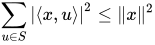
- Bessel's inequality states: given an orthonormal set S and a vector x in a Hilbert space,
- ,[1]
- bipolar
- bipolar theorem.
- bounded
- A bounded operator is a linear operator between Banach spaces for which the image of the unit ball is bounded.
- bornological
- A bornological space.
- Birkhoff orthogonality
- Two vectors x and y in a normed linear space are said to be Birkhoff orthogonal if for all scalars λ. If the normed linear space is a Hilbert space, then it is equivalent to the usual orthogonality.
- Borel
- Borel functional calculus






C
x, y</math> in an inner-product space,\n:<math>|\\langle x, y \\rangle| \\le \\|x\\| \\|y\\|</math>."}},"i":6}},"\n\n",{"template":{"target":{"wt":"term","href":"./Template:Term"},"params":{"1":{"wt":"Centraliser"}},"i":7}},"\n",{"template":{"target":{"wt":"defn","href":"./Template:Defn"},"params":{"no":{"wt":"1"},"1":{"wt":"The centraliser of an algebra A on which a weight w is defined is the subset K of A such that for a, b in K, w(ab)=w(ba), finite - i.e. w behaves like a trace on K."}},"i":8}},"\n\n",{"template":{"target":{"wt":"term","href":"./Template:Term"},"params":{"1":{"wt":"Centre"}},"i":9}},"\n",{"template":{"target":{"wt":"defn","href":"./Template:Defn"},"params":{"no":{"wt":"1"},"1":{"wt":"The centre Z of an algebra A is the subset of A which elements commute with all elements of A."}},"i":10}},"\n\n",{"template":{"target":{"wt":"term","href":"./Template:Term"},"params":{"1":{"wt":"Closed"}},"i":11}},"\n",{"template":{"target":{"wt":"defn","href":"./Template:Defn"},"params":{"no":{"wt":"1"},"1":{"wt":"The [[closed graph theorem]] states that a linear operator between Banach spaces is continuous (bounded) if and only if it has closed graph."}},"i":12}},"\n",{"template":{"target":{"wt":"defn","href":"./Template:Defn"},"params":{"no":{"wt":"2"},"1":{"wt":"A [[closed operator]] is a linear operator whose graph is closed."}},"i":13}},"\n",{"template":{"target":{"wt":"defn","href":"./Template:Defn"},"params":{"no":{"wt":"3"},"1":{"wt":"The [[closed range theorem]] says that a densely defined closed operator has closed image (range) if and only if the transpose of it has closed image."}},"i":14}},"\n\n",{"template":{"target":{"wt":"term","href":"./Template:Term"},"params":{"1":{"wt":"Commutant"}},"i":15}},"\n",{"template":{"target":{"wt":"defn","href":"./Template:Defn"},"params":{"no":{"wt":"1"},"1":{"wt":"The commutant of a subset ''S'' of an algebra A is the subalgebra of the elements of A commuting with each element of ''S'' and is denoted by <math>S'</math>."}},"i":16}},"\n",{"template":{"target":{"wt":"defn","href":"./Template:Defn"},"params":{"no":{"wt":"2"},"1":{"wt":"The [[von Neumann double commutant theorem]] states that a nondegenerate *-algebra <math>\\mathfrak{M}</math> of operators on a Hilbert space is a von Neumann algebra (i.e. is closed in the weak operator topology) if and only if <math>\\mathfrak{M}'' = \\mathfrak{M}</math>. Taking the double commutant is often a convenient way to build a weak closure - but one has to be explicit on the complete algebra A that is considered in the procedure."}},"i":17}},"\n\n",{"template":{"target":{"wt":"term","href":"./Template:Term"},"params":{"1":{"wt":"Compact"}},"i":18}},"\n",{"template":{"target":{"wt":"defn","href":"./Template:Defn"},"params":{"1":{"wt":"A [[compact operator]] is a linear operator between Banach spaces for which the image of the unit ball is precompact."}},"i":19}},"\n\n",{"template":{"target":{"wt":"term","href":"./Template:Term"},"params":{"1":{"wt":"Connes"}},"i":20}},"\n",{"template":{"target":{"wt":"defn","href":"./Template:Defn"},"params":{"1":{"wt":"[[Connes fusion]]."}},"i":21}},"\n\n",{"template":{"target":{"wt":"term","href":"./Template:Term"},"params":{"1":{"wt":"C*"}},"i":22}},"\n",{"template":{"target":{"wt":"defn","href":"./Template:Defn"},"params":{"1":{"wt":"A [[C*-algebra]] is an involutive Banach algebra satisfying <math>\\|x^* x\\| = \\|x^*\\| \\|x\\|</math>. It is closed in the operator norm topology. Von Neumann algebras that are closed in the weak operator topology are particular C*-algebras."}},"i":23}},"\n\n",{"template":{"target":{"wt":"term","href":"./Template:Term"},"params":{"1":{"wt":"Convex"}},"i":24}},"\n",{"template":{"target":{"wt":"defn","href":"./Template:Defn"},"params":{"1":{"wt":"A [[locally convex space]] is a topological vector space whose topology is generated by convex subsets."}},"i":25}},"\n\n",{"template":{"target":{"wt":"term","href":"./Template:Term"},"params":{"1":{"wt":"Cyclic"}},"i":26}},"\n",{"template":{"target":{"wt":"defn","href":"./Template:Defn"},"params":{"1":{"wt":"Given a representation <math>(\\pi, V)</math> of a Banach algebra <math>A</math>, a [[cyclic vector]] is a vector <math>v \\in V</math> such that <math>\\pi(A)v</math> is dense in <math>V</math>."}},"i":27}},"\n\n",{"template":{"target":{"wt":"glossary end","href":"./Template:Glossary_end"},"params":{},"i":28}}]}' id="mwHg"/>- c
- c space.
- Calkin
- The Calkin algebra on a Hilbert space is the quotient of the algebra of all bounded operators on the Hilbert space by the ideal generated by compact operators.
- Cauchy–Schwarz inequality
- The Cauchy–Schwarz inequality states: for each pair of vectors in an inner-product space,
- .
- Centraliser
- 1. The centraliser of an algebra A on which a weight w is defined is the subset K of A such that for a, b in K, w(ab)=w(ba), finite - i.e. w behaves like a trace on K.
- Centre
- 1. The centre Z of an algebra A is the subset of A which elements commute with all elements of A.
- Closed
- 1. The closed graph theorem states that a linear operator between Banach spaces is continuous (bounded) if and only if it has closed graph.
- 2. A closed operator is a linear operator whose graph is closed.
- 3. The closed range theorem says that a densely defined closed operator has closed image (range) if and only if the transpose of it has closed image.
- Commutant
- 1. The commutant of a subset S of an algebra A is the subalgebra of the elements of A commuting with each element of S and is denoted by .
- 2. The von Neumann double commutant theorem states that a nondegenerate *-algebra of operators on a Hilbert space is a von Neumann algebra (i.e. is closed in the weak operator topology) if and only if . Taking the double commutant is often a convenient way to build a weak closure - but one has to be explicit on the complete algebra A that is considered in the procedure.
- Compact
- A compact operator is a linear operator between Banach spaces for which the image of the unit ball is precompact.
- Connes
- Connes fusion.
- C*
- A C*-algebra is an involutive Banach algebra satisfying . It is closed in the operator norm topology. Von Neumann algebras that are closed in the weak operator topology are particular C*-algebras.
- Convex
- A locally convex space is a topological vector space whose topology is generated by convex subsets.
- Cyclic
- Given a representation of a Banach algebra , a cyclic vector is a vector such that is dense in .






D
- dilation
- dilation (operator theory).
- direct
- Philosophically, a direct integral is a continuous analog of a direct sum.
- Douglas
- Douglas' lemma
- Dunford
- Dunford–Schwartz theorem
- dual
- 1. The continuous dual of a topological vector space is the vector space of all the continuous linear functionals on the space.
- 2. The algebraic dual of a topological vector space is the dual vector space of the underlying vector space.
E
- Eidelheit
- A theorem of Eidelheit.
- essentially selfadjoint
- An essentially selfadjoint operator.
F
\\omega</math> on an involutive algebra is [[faithful linear functional|faithful]] if <math>\\omega(x^*x) \\ne 0</math> for each nonzero element <math>x</math> in the algebra."}},"i":4}},"\n\n",{"template":{"target":{"wt":"term","href":"./Template:Term"},"params":{"1":{"wt":"Fréchet"}},"i":5}},"\n",{"template":{"target":{"wt":"defn","href":"./Template:Defn"},"params":{"1":{"wt":"A [[Fréchet space]] is a topological vector space whose topology is given by a countable family of seminorms (which makes it a metric space) and that is complete as a metric space."}},"i":6}},"\n\n",{"template":{"target":{"wt":"term","href":"./Template:Term"},"params":{"1":{"wt":"Fredholm"}},"i":7}},"\n",{"template":{"target":{"wt":"defn","href":"./Template:Defn"},"params":{"1":{"wt":"A [[Fredholm operator]] is a bounded operator such that it has closed range and the kernels of the operator and the adjoint have finite-dimension."}},"i":8}},"\n\n",{"template":{"target":{"wt":"glossary end","href":"./Template:Glossary_end"},"params":{},"i":9}}]}' id="mwJw"/>- factor
- A factor is a von Neumann algebra with trivial center.
- faithful
- A linear functional on an involutive algebra is faithful if for each nonzero element in the algebra.
- Fréchet
- A Fréchet space is a topological vector space whose topology is given by a countable family of seminorms (which makes it a metric space) and that is complete as a metric space.
- Fredholm
- A Fredholm operator is a bounded operator such that it has closed range and the kernels of the operator and the adjoint have finite-dimension.


G
A</math> with spectrum <math>\\Omega(A)</math> is the algebra homomorphism <math>F: A \\to C_0(\\Omega(A))</math>, where <math>C_0(X)</math> denotes the algebra of continuous functions on <math>X</math> vanishing at infinity, that is given by <math>F(x)(\\omega) = \\omega(x)</math>. It is a *-preserving isometric isomorphism if <math>A</math> is a commutative C*-algebra."}},"i":3}},"\n\n",{"template":{"target":{"wt":"term","href":"./Template:Term"},"params":{"1":{"wt":"Grothendieck"}},"i":4}},"\n",{"template":{"target":{"wt":"defn","href":"./Template:Defn"},"params":{"no":{"wt":"1"},"1":{"wt":"[[Grothendieck's inequality]]."}},"i":5}},"\n",{"template":{"target":{"wt":"defn","href":"./Template:Defn"},"params":{"no":{"wt":"2"},"1":{"wt":"[[Grothendieck's factorization theorem]]."}},"i":6}},"\n\n",{"template":{"target":{"wt":"glossary end","href":"./Template:Glossary_end"},"params":{},"i":7}}]}' id="mwKg"/>- Gelfand
- 1. The Gelfand–Mazur theorem states that a Banach algebra that is a division ring is the field of complex numbers.
- 2. The Gelfand representation of a commutative Banach algebra with spectrum is the algebra homomorphism , where denotes the algebra of continuous functions on vanishing at infinity, that is given by . It is a *-preserving isometric isomorphism if is a commutative C*-algebra.
- Grothendieck
- 1. Grothendieck's inequality.
- 2. Grothendieck's factorization theorem.





H
\\ell</math> on a subspace of a complex vector space ''V'', if the absolute value of <math>\\ell</math> is bounded above by a seminorm on ''V'', then it extends to a linear functional on ''V'' still bounded by the seminorm. Geometrically, it is a generalization of the [[hyperplane separation theorem]]."}},"i":2}},"\n\n",{"template":{"target":{"wt":"term","href":"./Template:Term"},"params":{"1":{"wt":"Heine"}},"i":3}},"\n",{"template":{"target":{"wt":"defn","href":"./Template:Defn"},"params":{"1":{"wt":"A topological vector space is said to have the [[Heine–Borel property]] if every closed and bounded subset is compact. Riesz's lemma says a Banach space with the Heine–Borel property must be finite-dimensional."}},"i":4}},"\n\n",{"template":{"target":{"wt":"term","href":"./Template:Term"},"params":{"1":{"wt":"Hilbert"}},"i":5}},"\n",{"template":{"target":{"wt":"defn","href":"./Template:Defn"},"params":{"no":{"wt":"1"},"1":{"wt":"A [[Hilbert space]] is an inner product space that is complete as a metric space."}},"i":6}},"\n",{"template":{"target":{"wt":"defn","href":"./Template:Defn"},"params":{"no":{"wt":"2"},"1":{"wt":"In the [[Tomita–Takesaki theory]], a (left or right) Hilbert algebra is a certain algebra with an involution."}},"i":7}},"\n\n",{"template":{"target":{"wt":"term","href":"./Template:Term"},"params":{"1":{"wt":"Hilbert–Schmidt"}},"i":8}},"\n",{"template":{"target":{"wt":"defn","href":"./Template:Defn"},"params":{"no":{"wt":"1"},"1":{"wt":"The [[Hilbert–Schmidt norm]] of a bounded operator <math>T</math> on a Hilbert space is <math>\\sum_i \\|T e_i \\|^2</math> where <math>\\{ e_i \\}</math> is an orthonormal basis of the Hilbert space."}},"i":9}},"\n",{"template":{"target":{"wt":"defn","href":"./Template:Defn"},"params":{"no":{"wt":"2"},"1":{"wt":"A [[Hilbert–Schmidt operator]] is a bounded operator with finite Hilbert–Schmidt norm."}},"i":10}},"\n\n",{"template":{"target":{"wt":"glossary end","href":"./Template:Glossary_end"},"params":{},"i":11}}]}' id="mwLQ"/>- Hahn–Banach
- The Hahn–Banach theorem states: given a linear functional on a subspace of a complex vector space V, if the absolute value of is bounded above by a seminorm on V, then it extends to a linear functional on V still bounded by the seminorm. Geometrically, it is a generalization of the hyperplane separation theorem.
- Heine
- A topological vector space is said to have the Heine–Borel property if every closed and bounded subset is compact. Riesz's lemma says a Banach space with the Heine–Borel property must be finite-dimensional.
- Hilbert
- 1. A Hilbert space is an inner product space that is complete as a metric space.
- 2. In the Tomita–Takesaki theory, a (left or right) Hilbert algebra is a certain algebra with an involution.
- Hilbert–Schmidt
- 1. The Hilbert–Schmidt norm of a bounded operator on a Hilbert space is where is an orthonormal basis of the Hilbert space.
- 2. A Hilbert–Schmidt operator is a bounded operator with finite Hilbert–Schmidt norm.


I
T : H_1 \\to H_2</math> is the integer <math>\\operatorname{dim}(\\operatorname{ker}(T^*)) - \\operatorname{dim}(\\operatorname{ker}(T))</math>."}},"i":2}},"\n",{"template":{"target":{"wt":"defn","href":"./Template:Defn"},"params":{"no":{"wt":"2"},"1":{"wt":"The [[Atiyah–Singer index theorem]]."}},"i":3}},"\n\n",{"template":{"target":{"wt":"term","href":"./Template:Term"},"params":{"1":{"wt":"index group"}},"i":4}},"\n",{"template":{"target":{"wt":"defn","href":"./Template:Defn"},"params":{"1":{"wt":"The [[index group]] of a unital Banach algebra is the quotient group <math>G(A)/G_0(A)</math> where <math>G(A)</math> is the unit group of ''A'' and <math>G_0(A)</math> the identity component of the group."}},"i":5}},"\n\n",{"template":{"target":{"wt":"term","href":"./Template:Term"},"params":{"1":{"wt":"infra-barrelled"}},"i":6}},"\n",{"template":{"target":{"wt":"defn","href":"./Template:Defn"},"params":{"1":{"wt":"[[infra-barrelled]]"}},"i":7}},"\n\n",{"template":{"target":{"wt":"term","href":"./Template:Term"},"params":{"1":{"wt":"inner product"}},"i":8}},"\n",{"template":{"target":{"wt":"defn","href":"./Template:Defn"},"params":{"no":{"wt":"1"},"1":{"wt":"An [[inner product]] on a real or complex vector space <math>V</math> is a function <math>\\langle \\cdot, \\cdot \\rangle : V \\times V \\to \\mathbb{R}</math> such that for each <math>v, w \\in V</math>, (1) <math>x \\mapsto \\langle x, v \\rangle</math> is linear and (2) <math>\\langle v, w \\rangle = \\overline{\\langle w, v\\rangle}</math> where the bar means complex conjugate."}},"i":9}},"\n",{"template":{"target":{"wt":"defn","href":"./Template:Defn"},"params":{"no":{"wt":"2"},"1":{"wt":"An [[inner product space]] is a vector space equipped with an inner product."}},"i":10}},"\n\n",{"template":{"target":{"wt":"term","href":"./Template:Term"},"params":{"1":{"wt":"involution"}},"i":11}},"\n",{"template":{"target":{"wt":"defn","href":"./Template:Defn"},"params":{"no":{"wt":"1"},"1":{"wt":"An [[Involution (mathematics)|involution]] of a Banach algebra ''A'' is an isometric endomorphism <math>A \\to A, \\, x \\mapsto x^*</math> that is conjugate-linear and such that <math>(xy)^* = (yx)^*</math>."}},"i":12}},"\n",{"template":{"target":{"wt":"defn","href":"./Template:Defn"},"params":{"no":{"wt":"2"},"1":{"wt":"An [[involutive Banach algebra]] is a Banach algebra equipped with an involution."}},"i":13}},"\n\n",{"template":{"target":{"wt":"term","href":"./Template:Term"},"params":{"1":{"wt":"isometry"}},"i":14}},"\n",{"template":{"target":{"wt":"defn","href":"./Template:Defn"},"params":{"1":{"wt":"A [[linear isometry]] between normed vector spaces is a linear map preserving norm."}},"i":15}},"\n\n",{"template":{"target":{"wt":"glossary end","href":"./Template:Glossary_end"},"params":{},"i":16}}]}' id="mwMA"/>- index
- 1. The index of a Fredholm operator is the integer .
- 2. The Atiyah–Singer index theorem.
- index group
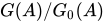
- The index group of a unital Banach algebra is the quotient group where is the unit group of A and the identity component of the group.
- infra-barrelled
- infra-barrelled
- inner product
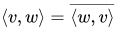
- 1. An inner product on a real or complex vector space is a function such that for each , (1) is linear and (2) where the bar means complex conjugate.
- 2. An inner product space is a vector space equipped with an inner product.
- involution
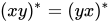
- 1. An involution of a Banach algebra A is an isometric endomorphism that is conjugate-linear and such that .
- 2. An involutive Banach algebra is a Banach algebra equipped with an involution.
- isometry
- A linear isometry between normed vector spaces is a linear map preserving norm.







K
- Kato–Rellich
- The Kato–Rellich theorem
- Köthe
- A Köthe sequence space. For now, see https://mathoverflow.net/questions/361048/on-k%C3%B6the-sequence-spaces
- Krein–Milman
- The Krein–Milman theorem states: a nonempty compact convex subset of a locally convex space has an extremal point.
- Krein–Smulian
- Krein–Smulian theorem
L
- Linear
- Linear Operators is a three-value book by Dunford and Schwartz.
- Locally convex algebra
- A locally convex algebra is an algebra whose underlying vector space is a locally convex space and whose multiplication is continuous with respect to the locally convex space topology.
M
- Mazur
- Mazur–Ulam theorem.
- Montel
- Montel space.
N
(\\pi, V)</math> of an algebra <math>A</math> is said to be nondegenerate if for each vector <math>v \\in V</math>, there is an element <math>a \\in A</math> such that <math>\\pi(a) v \\ne 0</math>."}},"i":2}},"\n\n",{"template":{"target":{"wt":"term","href":"./Template:Term"},"params":{"1":{"wt":"noncommutative"}},"i":3}},"\n",{"template":{"target":{"wt":"defn","href":"./Template:Defn"},"params":{"no":{"wt":"1"},"1":{"wt":"[[noncommutative integration]]"}},"i":4}},"\n",{"template":{"target":{"wt":"defn","href":"./Template:Defn"},"params":{"no":{"wt":"2"},"1":{"wt":"[[noncommutative torus]]"}},"i":5}},"\n\n",{"template":{"target":{"wt":"term","href":"./Template:Term"},"params":{"1":{"wt":"norm"}},"i":6}},"\n",{"template":{"target":{"wt":"defn","href":"./Template:Defn"},"params":{"no":{"wt":"1"},"1":{"wt":"A [[norm (mathematics)|norm]] on a vector space ''X'' is a real-valued function <math>\\| \\cdot \\| : X \\to \\mathbb{R}</math> such that for each scalar <math>a</math> and vectors <math>x, y</math> in <math>X</math>, (1) <math>\\| ax\\| = |a| \\| x \\|</math>, (2) (triangular inequality) <math>\\| x + y \\| \\le \\| x \\| + \\| y \\|</math> and (3) <math>\\| x \\| \\ge 0</math> where the equality holds only for <math>x = 0</math>."}},"i":7}},"\n",{"template":{"target":{"wt":"defn","href":"./Template:Defn"},"params":{"no":{"wt":"2"},"1":{"wt":"A [[normed vector space]] is a real or complex vector space equipped with a norm <math>\\| \\cdot \\|</math>. It is a metric space with the distance function <math>d(x, y) = \\| x - y \\|</math>."}},"i":8}},"\n\n",{"template":{"target":{"wt":"term","href":"./Template:Term"},"params":{"1":{"wt":"normal"}},"i":9}},"\n",{"template":{"target":{"wt":"defn","href":"./Template:Defn"},"params":{"1":{"wt":"An operator is [[normal operator|normal]] if it and its adjoint commute."}},"i":10}},"\n\n",{"template":{"target":{"wt":"term","href":"./Template:Term"},"params":{"1":{"wt":"nuclear"}},"i":11}},"\n",{"template":{"target":{"wt":"defn","href":"./Template:Defn"},"params":{"no":{"wt":"1"},"1":{"wt":"[[nuclear operator]]."}},"i":12}},"\n",{"template":{"target":{"wt":"defn","href":"./Template:Defn"},"params":{"no":{"wt":"2"},"1":{"wt":"[[nuclear space]]."}},"i":13}},"\n\n",{"template":{"target":{"wt":"glossary end","href":"./Template:Glossary_end"},"params":{},"i":14}}]}' id="mwPA"/>- nondegenerate
- A representation of an algebra is said to be nondegenerate if for each vector , there is an element such that .
- noncommutative
- 1. noncommutative integration
- 2. noncommutative torus
- norm
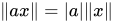
- 1. A norm on a vector space X is a real-valued function such that for each scalar and vectors in , (1) , (2) (triangular inequality) and (3) where the equality holds only for .
- 2. A normed vector space is a real or complex vector space equipped with a norm . It is a metric space with the distance function .
- normal
- An operator is normal if it and its adjoint commute.
- nuclear
- 1. nuclear operator.
- 2. nuclear space.








O
(\\mathbb{R}, +)</math> to the unit group of ''A''."}},"i":2}},"\n\n",{"template":{"target":{"wt":"term","href":"./Template:Term"},"params":{"1":{"wt":"open"}},"i":3}},"\n",{"template":{"target":{"wt":"defn","href":"./Template:Defn"},"params":{"1":{"wt":"The [[open mapping theorem (functional analysis)|open mapping theorem]] says a surjective continuous linear operator between Banach spaces is an open mapping."}},"i":4}},"\n\n",{"template":{"target":{"wt":"term","href":"./Template:Term"},"params":{"1":{"wt":"orthonormal"}},"i":5}},"\n",{"template":{"target":{"wt":"defn","href":"./Template:Defn"},"params":{"no":{"wt":"1"},"1":{"wt":"A subset ''S'' of a Hilbert space is [[orthonormal]] if, for each ''u'', ''v'' in the set, <math>\\langle u, v \\rangle</math> = 0 when <math>u \\ne v</math> and <math>= 1</math> when <math>u = v</math>."}},"i":6}},"\n",{"template":{"target":{"wt":"defn","href":"./Template:Defn"},"params":{"no":{"wt":"2"},"1":{"wt":"An [[orthonormal basis]] is a maximal orthonormal set (note: it is *not* necessarily a vector space basis.)"}},"i":7}},"\n\n",{"template":{"target":{"wt":"term","href":"./Template:Term"},"params":{"1":{"wt":"orthogonal"}},"i":8}},"\n",{"template":{"target":{"wt":"defn","href":"./Template:Defn"},"params":{"no":{"wt":"1"},"1":{"wt":"Given a Hilbert space ''H'' and a closed subspace ''M'', the [[orthogonal complement]] of ''M'' is the closed subspace <math>M^{\\bot} = \\{ x \\in H | \\langle x, y \\rangle = 0, y \\in M \\}</math>."}},"i":9}},"\n",{"template":{"target":{"wt":"defn","href":"./Template:Defn"},"params":{"no":{"wt":"2"},"1":{"wt":"In the notations above, the [[orthogonal projection]] <math>P</math> onto ''M'' is a (unique) bounded operator on ''H'' such that <math>P^2 = P, P^* = P, \\operatorname{im}(P) = M, \\operatorname{ker}(P) = M^{\\bot}.</math>"}},"i":10}},"\n\n",{"template":{"target":{"wt":"glossary end","href":"./Template:Glossary_end"},"params":{},"i":11}}]}' id="mwPw"/>- one
- A one parameter group of a unital Banach algebra A is a continuous group homomorphism from to the unit group of A.
- open
- The open mapping theorem says a surjective continuous linear operator between Banach spaces is an open mapping.
- orthonormal
- 1. A subset S of a Hilbert space is orthonormal if, for each u, v in the set, = 0 when and when .
- 2. An orthonormal basis is a maximal orthonormal set (note: it is *not* necessarily a vector space basis.)
- orthogonal
- 1. Given a Hilbert space H and a closed subspace M, the orthogonal complement of M is the closed subspace .
- 2. In the notations above, the orthogonal projection onto M is a (unique) bounded operator on H such that





P
\\| x \\|^2 = \\sum_{u \\in S} |\\langle x, u \\rangle|^2</math>.<ref name=\"sum convention\">Here, the part of the assertion is <math>\\sum_{u \\in S} \\cdots</math> is well-defined; i.e., when ''S'' is infinite, for countable totally ordered subsets <math>S' \\subset S</math>, <math>\\sum_{u \\in S'} \\cdots</math> is independent of <math>S'</math> and <math>\\sum_{u \\in S} \\cdots</math> denotes the common value.</ref>"}},"i":2}},"\n\n",{"template":{"target":{"wt":"term","href":"./Template:Term"},"params":{"1":{"wt":"positive"}},"i":3}},"\n",{"template":{"target":{"wt":"defn","href":"./Template:Defn"},"params":{"1":{"wt":"A linear functional <math>\\omega</math> on an involutive Banach algebra is said to be [[positive linear functional|positive]] if <math>\\omega(x^* x) \\ge 0</math> for each element <math>x</math> in the algebra."}},"i":4}},"\n\n",{"template":{"target":{"wt":"term","href":"./Template:Term"},"params":{"1":{"wt":"predual"}},"i":5}},"\n",{"template":{"target":{"wt":"defn","href":"./Template:Defn"},"params":{"1":{"wt":"[[predual]]."}},"i":6}},"\n\n",{"template":{"target":{"wt":"term","href":"./Template:Term"},"params":{"1":{"wt":"projection"}},"i":7}},"\n",{"template":{"target":{"wt":"defn","href":"./Template:Defn"},"params":{"1":{"wt":"An operator ''T'' is called a [[projection (functional analysis)|projection]] if it is an idempotent; i.e., <math>T^2 = T</math>."}},"i":8}},"\n\n",{"template":{"target":{"wt":"glossary end","href":"./Template:Glossary_end"},"params":{},"i":9}}]}' id="mwQg"/>- Parseval
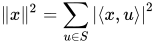
- Parseval's identity states: given an orthonormal basis S in a Hilbert space, .[1]
- positive
- A linear functional on an involutive Banach algebra is said to be positive if for each element in the algebra.
- predual
- predual.
- projection
- An operator T is called a projection if it is an idempotent; i.e., .


Q
- quasitrace
- Quasitrace.
R
\\mathbb{C}</math> of the spectrum of ''x''."}},"i":10}},"\n\n",{"template":{"target":{"wt":"term","href":"./Template:Term"},"params":{"1":{"wt":"Ryll-Nardzewski"}},"i":11}},"\n",{"template":{"target":{"wt":"defn","href":"./Template:Defn"},"params":{"1":{"wt":"[[Ryll-Nardzewski fixed-point theorem]]."}},"i":12}},"\n\n",{"template":{"target":{"wt":"glossary end","href":"./Template:Glossary_end"},"params":{},"i":13}}]}' id="mwTA"/>- Radon
- See Radon measure.
- Riesz decomposition
- Riesz decomposition.
- Riesz's lemma
- Riesz's lemma.
- reflexive
- A reflexive space is a topological vector space such that the natural map from the vector space to the second (topological) dual is an isomorphism.
- resolvent
- The resolvent of an element x of a unital Banach algebra is the complement in of the spectrum of x.
- Ryll-Nardzewski
- Ryll-Nardzewski fixed-point theorem.

S
\\lambda</math> such that <math>x - \\lambda</math> is not invertible."}},"i":14}},"\n",{"template":{"target":{"wt":"defn","href":"./Template:Defn"},"params":{"no":{"wt":"2"},"1":{"wt":"The [[spectrum of a commutative Banach algebra]] is the set of all characters (a homomorphism to <math>\\mathbb{C}</math>) on the algebra."}},"i":15}},"\n\n",{"template":{"target":{"wt":"term","href":"./Template:Term"},"params":{"1":{"wt":"spectral"}},"i":16}},"\n",{"template":{"target":{"wt":"defn","href":"./Template:Defn"},"params":{"no":{"wt":"1"},"1":{"wt":"The [[spectral radius]] of an element ''x'' of a unital Banach algebra is <math display=\"inline\">\\sup_{\\lambda} |\\lambda|</math> where the sup is over the spectrum of ''x''."}},"i":17}},"\n",{"template":{"target":{"wt":"defn","href":"./Template:Defn"},"params":{"no":{"wt":"2"},"1":{"wt":"The [[spectral mapping theorem]] states: if ''x'' is an element of a unital Banach algebra and ''f'' is a holomorphic function in a neighborhood of the spectrum <math>\\sigma(x)</math> of ''x'', then <math>f(\\sigma(x)) = \\sigma(f(x))</math>, where <math>f(x)</math> is an element of the Banach algebra defined via the [[Cauchy's integral formula]]."}},"i":18}},"\n\n",{"template":{"target":{"wt":"term","href":"./Template:Term"},"params":{"1":{"wt":"state"}},"i":19}},"\n",{"template":{"target":{"wt":"defn","href":"./Template:Defn"},"params":{"1":{"wt":"A [[state (functional analysis)|state]] is a positive linear functional of norm one."}},"i":20}},"\n\n",{"template":{"target":{"wt":"term","href":"./Template:Term"},"params":{"1":{"wt":"Stone"}},"i":21}},"\n",{"template":{"target":{"wt":"defn","href":"./Template:Defn"},"params":{"1":{"wt":"[[Stone lemma]]."}},"i":22}},"\n\n",{"template":{"target":{"wt":"term","href":"./Template:Term"},"params":{"1":{"wt":"symmetric"}},"i":23}},"\n",{"template":{"target":{"wt":"defn","href":"./Template:Defn"},"params":{"1":{"wt":"A linear operator ''T'' on a pre-Hilbert space is [[symmetric operator|symmetric]] if <math>(Tx, y) = (x, Ty).</math>"}},"i":24}},"\n\n",{"template":{"target":{"wt":"glossary end","href":"./Template:Glossary_end"},"params":{},"i":25}}]}' id="mwTw"/>- Schauder
- Schauder basis.
- Schatten
- Schatten class
- selection
- Michael selection theorem.
- self-adjoint
- A self-adjoint operator is a bounded operator whose adjoint is itself. More generally, a closed densely defined operator is called self-adjoint if it coincides with the adjoint including the domain.
- semi-reflexive
- A locally convex space is called semi-reflexive space if the canonical map to the second continuous dual is surjective.
- separable
- A separable Hilbert space is a Hilbert space admitting a finite or countable orthonormal basis.
- spectrum
- 1. The spectrum of an element x of a unital Banach algebra is the set of complex numbers such that is not invertible.
- 2. The spectrum of a commutative Banach algebra is the set of all characters (a homomorphism to ) on the algebra.
- spectral
- 1. The spectral radius of an element x of a unital Banach algebra is where the sup is over the spectrum of x.
- 2. The spectral mapping theorem states: if x is an element of a unital Banach algebra and f is a holomorphic function in a neighborhood of the spectrum of x, then , where is an element of the Banach algebra defined via the Cauchy's integral formula.
- state
- A state is a positive linear functional of norm one.
- Stone
- Stone lemma.
- symmetric
- A linear operator T on a pre-Hilbert space is symmetric if





T
(x, y) \\mapsto x + y</math> as well as scalar multiplication <math>(\\lambda, x) \\mapsto \\lambda x</math> are continuous."}},"i":5}},"\n",{"template":{"target":{"wt":"defn","href":"./Template:Defn"},"params":{"no":{"wt":"2"},"1":{"wt":"A linear map <math>f: E \\to F</math> is called a [[topological homomorphism]] if <math>f : E \\to \\operatorname{im}(f)</math> is an open mapping."}},"i":6}},"\n",{"template":{"target":{"wt":"defn","href":"./Template:Defn"},"params":{"no":{"wt":"3"},"1":{"wt":"A sequence <math>\\cdots \\to E_{n -1} \\to E_n \\to E_{n+1} \\to \\cdots</math> is called [[topologically exact]] if it is an [[exact sequence]] on the underlying vector spaces and, moreover, each <math> E_n \\to E_{n+1}</math> is a topological homomorphism."}},"i":7}},"\n\n",{"template":{"target":{"wt":"glossary end","href":"./Template:Glossary_end"},"params":{},"i":8}}]}' id="mwUg"/>- tensor product
- 1. See topological tensor product. Note it is still somewhat of an open problem to define or work out a correct tensor product of topological vector spaces, including Banach spaces.
- 2. A projective tensor product.
- topological
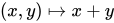
- 1. A topological vector space is a vector space equipped with a topology such that (1) the topology is Hausdorff and (2) the addition as well as scalar multiplication are continuous.
- 2. A linear map is called a topological homomorphism if is an open mapping.
- 3. A sequence is called topologically exact if it is an exact sequence on the underlying vector spaces and, moreover, each is a topological homomorphism.


U
\\sup_T |Tx| < \\infty</math>, sup over the set, for each ''x'' in the Banach space, then <math display=\"inline\">\\sup_T \\|T\\| < \\infty</math>."}},"i":6}},"\n\n",{"template":{"target":{"wt":"term","href":"./Template:Term"},"params":{"1":{"wt":"unitary"}},"i":7}},"\n",{"template":{"target":{"wt":"defn","href":"./Template:Defn"},"params":{"no":{"wt":"1"},"1":{"wt":"A [[unitary operator]] between Hilbert spaces is an invertible bounded linear operator such that the inverse is the adjoint of the operator."}},"i":8}},"\n",{"template":{"target":{"wt":"defn","href":"./Template:Defn"},"params":{"no":{"wt":"2"},"1":{"wt":"Two representations <math>(\\pi_1, H_1), (\\pi_2, H_2)</math> of an involutive Banach algebra ''A'' on Hilbert spaces <math>H_1, H_2</math> are said to be [[unitary representation|unitarily equivalent]] if there is a unitary operator <math>U: H_1 \\to H_2</math> such that <math>\\pi_2(x) U = U \\pi_1(x)</math> for each ''x'' in ''A''."}},"i":9}},"\n\n",{"template":{"target":{"wt":"glossary end","href":"./Template:Glossary_end"},"params":{},"i":10}}]}' id="mwVQ"/>- ultraweak
- ultraweak topology.
- unbounded operator
- An unbounded operator is a partially defined linear operator, usually defined on a dense subspace.
- uniform boundedness principle
- The uniform boundedness principle states: given a set of operators between Banach spaces, if , sup over the set, for each x in the Banach space, then .
- unitary
- 1. A unitary operator between Hilbert spaces is an invertible bounded linear operator such that the inverse is the adjoint of the operator.
- 2. Two representations of an involutive Banach algebra A on Hilbert spaces are said to be unitarily equivalent if there is a unitary operator such that for each x in A.






V
- von Neumann
- 1. A von Neumann algebra.
- 2. von Neumann's theorem.
- 3. Von Neumann's inequality.
W
- W*
- A W*-algebra is a C*-algebra that admits a faithful representation on a Hilbert space such that the image of the representation is a von Neumann algebra.
References


- Bourbaki, Espaces vectoriels topologiques
- Connes, Alain (1994), Non-commutative geometry, Boston, MA: Academic Press, ISBN 978-0-12-185860-5
- Conway, John B. (1990). A Course in Functional Analysis. Graduate Texts in Mathematics. Vol. 96 (2nd ed.). New York: Springer-Verlag. ISBN 978-0-387-97245-9. OCLC 21195908.
- Dunford, Nelson; Schwartz, Jacob T. (1988). Linear Operators. Pure and applied mathematics. Vol. 1. New York: Wiley-Interscience. ISBN 978-0-471-60848-6. OCLC 18412261.
- Rudin, Walter (1991). Functional Analysis. International Series in Pure and Applied Mathematics. Vol. 8 (Second ed.). New York, NY: McGraw-Hill Science/Engineering/Math. ISBN 978-0-07-054236-5. OCLC 21163277.
- M. Takesaki, Theory of Operator Algebras I, Springer, 2001, 2nd printing of the first edition 1979.
- Yoshida, Kôsaku (1980), Functional Analysis (sixth ed.), Springer
Further reading
- Antony Wassermann's lecture notes at http://iml.univ-mrs.fr/~wasserm/
- Jacob Lurie's lecture notes on a von Neumann algebra at https://www.math.ias.edu/~lurie/261y.html
- https://mathoverflow.net/questions/408415/takesaki-theorem-2-6
| Spaces |
| ||||
|---|---|---|---|---|---|
| Theorems | |||||
| Operators | |||||
| Algebras | |||||
| Open problems | |||||
| Applications | |||||
| Advanced topics | |||||
