Texto da Wikipédia (en), licença CC BY-SA. O BETARUBI mostra o verbete inteiro nesta página — a leitura não continua fora do site.
The Algorithm
- Choose initial guess
 , two other vectors
  and
and  and a preconditioner


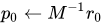
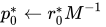
- for
 do
do
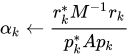




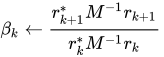


In the above formulation, the computed  and
and  satisfy


and thus are the respective residuals corresponding to  and
and  , as approximate solutions to the systems


 is the adjoint, and
  is the complex conjugate.
Unpreconditioned version of the algorithm
- Choose initial guess ,
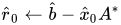


- for do
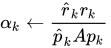


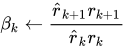


Discussion
The biconjugate gradient method is numerically unstable[citation needed] (compare to the biconjugate gradient stabilized method), but very important from a theoretical point of view. Define the iteration steps by


where  using the related projection

with
![{\displaystyle \mathbf {u} _{k}=\left[u_{0},u_{1},\dots ,u_{k-1}\right],}](https://wikimedia.org/api/rest_v1/media/math/render/svg/356e9dd32012d4b25f4a3c78179554570098e78e)
![{\displaystyle \mathbf {v} _{k}=\left[v_{0},v_{1},\dots ,v_{k-1}\right].}](https://wikimedia.org/api/rest_v1/media/math/render/svg/0f9338d3797abffd4007c6c2ab27aaed7e04e893)
These related projections may be iterated themselves as

A relation to Quasi-Newton methods is given by  and
and  , where

The new directions


are then orthogonal to the residuals:


which themselves satisfy

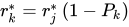
where  .
.
The biconjugate gradient method now makes a special choice and uses the setting
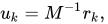
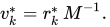
With this particular choice, explicit evaluations of  and A−1 are avoided, and the algorithm takes the form stated above.
Properties
- If
 is self-adjoint,
  and
and  , then
  ,
,  , and the conjugate gradient method produces the same sequence
  at half the computational cost.
- The sequences produced by the algorithm are biorthogonal, i.e.,
 for
for  .
.
- if
 is a polynomial with
 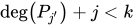 , then
  . The algorithm thus produces projections onto the Krylov subspace.
- if
 is a polynomial with
  , then
  .
.
References
- Fletcher, R. (1976). "Conjugate gradient methods for indefinite systems". In Watson, G. Alistair (ed.). Numerical analysis : proceedings of the Dundee Conference on Numerical Analysis. Lecture Notes in Mathematics. Vol. 506. Springer. pp. 73–89. doi:10.1007/BFb0080116. ISBN 978-3-540-07610-0.
- Press, WH; Teukolsky, SA; Vetterling, WT; Flannery, BP (2007). "Section 2.7.6". Numerical Recipes: The Art of Scientific Computing (3rd ed.). New York: Cambridge University Press. ISBN 978-0-521-88068-8.
|
|---|
| Key concepts | |
|---|
| Problems | |
|---|
| Hardware | |
|---|
| Software | |
|---|



