Texto da Wikipédia (en), licença CC BY-SA. O BETARUBI mostra o verbete inteiro nesta página — a leitura não continua fora do site.
Introduction
Consider a unit fraction, like 1/3 or 1/7. In base ten, the remainder, and so the digits, of 1/3 repeats at once: 0.3333.... However, the remainders of 1/7 repeat over six, or 7−1, digits: 1/7 = 0·142857142857142857... Examining the multiples of 1/7, each is a cyclic permutation of these six digits: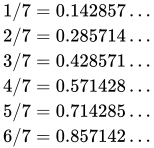
If the digits are laid out as a square, each row and column sums to 1 + 4 + 2 + 8 + 5 + 7 = 27. This yields the smallest base-10 non-normal, prime reciprocal magic square:
| 1 | 4 | 2 | 8 | 5 | 7 |
| 2 | 8 | 5 | 7 | 1 | 4 |
| 4 | 2 | 8 | 5 | 7 | 1 |
| 5 | 7 | 1 | 4 | 2 | 8 |
| 7 | 1 | 4 | 2 | 8 | 5 |
| 8 | 5 | 7 | 1 | 4 | 2 |
In contrast with its rows and columns, the diagonals of this square do not sum to 27; however, their mean is 27, as one diagonal adds to 23 while the other adds to 31.
All prime reciprocals in any base with a  period will generate magic squares where all rows and columns produce a magic constant, and only a select few will be full, such that their diagonals, rows and columns collectively yield equal sums.
Decimal expansions
In a full, or otherwise prime reciprocal magic square with period, the even number of k−th rows in the square are arranged by multiples of  — not necessarily consecutively — where a magic constant can be obtained.
For instance, an even repeating cycle from an odd, prime reciprocal of p that is divided into n−digit strings creates pairs of complementary sequences of digits that yield strings of nines (9) when added together:

This is a result of Midy's theorem.[1][2] These complementary sequences are generated between multiples of prime reciprocals that add to 1.
More specifically, a factor n in the numerator of the reciprocal of a prime number p will shift the decimal places of its decimal expansion accordingly:

In this case, a factor of 2 moves the repeating decimal of 1/23 by eight places.
A uniform solution of a prime reciprocal magic square, whether full or not, will hold rows with successive multiples of . Other magic squares can be constructed whose rows do not represent consecutive multiples of , which nonetheless generate a magic sum.
Magic constant
some prime numbers that generate prime-reciprocal magic squares in given bases
| Prime | Base | Magic sum |
|---|
| 19 | 10 | 81 |
| 53 | 12 | 286 |
| 59 | 2 | 29 |
| 67 | 2 | 33 |
| 83 | 2 | 41 |
| 89 | 19 | 792 |
| 211 | 2 | 105 |
| 223 | 3 | 222 |
| 307 | 5 | 612 |
| 383 | 10 | 1,719 |
| 397 | 5 | 792 |
| 487 | 6 | 1,215 |
| 593 | 3 | 592 |
| 631 | 87 | 27,090 |
| 787 | 13 | 4,716 |
| 811 | 3 | 810 |
| 1,033 | 11 | 5,160 |
| 1,307 | 5 | 2,612 |
| 1,499 | 11 | 7,490 |
| 1,877 | 19 | 16,884 |
| 2,011 | 26 | 25,125 |
| 2,027 | 2 | 1,013 |
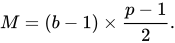
Magic squares based on reciprocals of primes p in bases b with periods have magic sums equal to[citation needed]
Full magic squares
The  magic square with maximum period 18 contains a row-and-column total of 81, that is also obtained by both diagonals. This makes it the first full, non-normal base-10 prime reciprocal magic square whose multiples fit inside respective
  −th rows:[3][4]

The first few prime numbers in decimal whose reciprocals can be used to produce a non-normal, full prime reciprocal magic square of this type are[5]
- {19, 383, 32327, 34061, 45341, 61967, 65699, 117541, 158771, 405817, ...} (sequence A072359 in the OEIS).
The smallest prime number to yield such magic square in binary is 59 (1110112), while in ternary it is 223 (220213); these are listed at A096339, and A096660.
Variations
A  prime reciprocal magic square with maximum period of 16 and magic constant of 72 can be constructed where its rows represent non-consecutive multiples of one-seventeenth:[6][7]

As such, this full magic square is the first of its kind in decimal that does not admit a uniform solution where consecutive multiples of fit in respective −th rows.
References
- ↑ Rademacher, Hans; Toeplitz, Otto (1957). The Enjoyment of Mathematics: Selections from Mathematics for the Amateur (2nd ed.). Princeton, NJ: Princeton University Press. pp. 158–160. ISBN 9780486262420. MR 0081844. OCLC 20827693. Zbl 0078.00114.
- ↑ Leavitt, William G. (1967). "A Theorem on Repeating Decimals". The American Mathematical Monthly. 74 (6). Washington, D.C.: Mathematical Association of America: 669–673. doi:10.2307/2314251. JSTOR 2314251. MR 0211949. Zbl 0153.06503.
- ↑ Andrews, William Symes (1917). Magic Squares and Cubes (PDF). Chicago, IL: Open Court Publishing Company. pp. 176, 177. ISBN 9780486206585. MR 0114763. OCLC 1136401. Zbl 1003.05500.
- ↑ Sloane, N. J. A. (ed.). "Sequence A021023 (Decimal expansion of 1/19.)". The On-Line Encyclopedia of Integer Sequences. OEIS Foundation. Retrieved 2023-11-21.
- ↑ Singleton, Colin R.J., ed. (1999). "Solutions to Problems and Conjectures". Journal of Recreational Mathematics. 30 (2). Amityville, NY: Baywood Publishing & Co.: 158–160.
- "Fourteen primes less than 1000000 possess this required property [in decimal]".
- Solution to problem 2420, "Only 19?" by M. J. Zerger.
- ↑ Subramani, K. (2020). "On two interesting properties of primes, p, with reciprocals in base 10 having maximum period p – 1" (PDF). J. Of Math. Sci. & Comp. Math. 1 (2). Auburn, WA: S.M.A.R.T.: 198–200. doi:10.15864/jmscm.1204. eISSN 2644-3368. S2CID 235037714.
- ↑ Sloane, N. J. A. (ed.). "Sequence A007450 (Decimal expansion of 1/17.)". The On-Line Encyclopedia of Integer Sequences. OEIS Foundation. Retrieved 2023-11-24.
|
|---|
| Types | | |
|---|
| Related shapes | |
|---|
| Higher dimensional shapes | |
|---|
| Classification | |
|---|
| Related concepts | |
|---|

