
BETA ZEN
Landau distribution
Texto da Wikipédia (en), licença CC BY-SA. O BETARUBI mostra o verbete inteiro nesta página — a leitura não continua fora do site.

| Landau distribution | |||
|---|---|---|---|
|
Probability density function  | |||
| Parameters | — location parameter | ||
| Support | |||
| Mean | Undefined | ||
| Variance | Undefined | ||
| MGF | Undefined | ||
| CF | |||



In probability theory, the Landau distribution is a probability distribution named after Lev Landau who used it in 1944.[1]
Because of the distribution's "fat" tail, the moments of the distribution, such as mean or variance, are undefined. The distribution is a particular case of stable distribution.
Definition
The probability density function, as written originally by Landau, is defined by the complex integral:

where a is an arbitrary positive real number, meaning that the integration path can be any parallel to the imaginary axis, intersecting the real positive semi-axis, and refers to the natural logarithm. In other words, it is the inverse Laplace transform of the function .[2]


The following real integral is equivalent to the above:

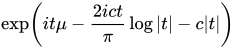
The full family of Landau distributions is obtained by extending the original distribution to a location-scale family of stable distributions with parameters and ,[3] with characteristic function:[4]


where and , which yields a density function:

Taking and we get the original form of above.


Properties


- Translation: If then .
- Scaling: If then .
- Sum: If and then .






These properties can all be derived from the characteristic function. Together they imply that the Landau distributions are closed under affine transformations.
Approximations
In the "standard" case and , the pdf can be approximated[5] using Lindhard theory which says:


where is Euler's constant.

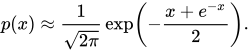
A similar approximation [6][7] of for and is:


Applications
In nuclear and particle physics, the Landau distribution appears as a probability that a fast particle with a given initial energy will lose a given energy after passing the layer of matter with given thickness.[8]
Related distributions
- The Landau distribution is a stable distribution with stability parameter and skewness parameter both equal to 1.


References
- ↑ Landau, L. (1944). "On the energy loss of fast particles by ionization". J. Phys. (USSR). 8: 201.
- ↑ Grupen, Claus; Shwartz, Boris (2008). Particle Detectors. Cambridge Monographs on Particle Physics, Nuclear Physics and Cosmology. Vol. 26 (2nd ed.). Cambridge University Press. ISBN 9781009401494.[page needed]
- ↑ Gentle, James E. (2003). Random Number Generation and Monte Carlo Methods. Statistics and Computing (2nd ed.). New York, NY: Springer. p. 196. doi:10.1007/b97336. ISBN 978-0-387-00178-4.
- ↑ Zolotarev, V.M. (1986). One-dimensional stable distributions. Providence, R.I.: American Mathematical Society. ISBN 0-8218-4519-5.
- ↑ "LandauDistribution—Wolfram Language Documentation".
- ↑ Behrends, S. E.; Melissinos, A.C. Properties of argon-ethane/methane mixtures for use in proportional counters, Univ. of Rochester Preprint UR-776 (1981). doi:10.1016/0029-554X(81)90263-9.
- ↑ Moyal, J.E. (1955). "Theory of ionization fluctuations". The London, Edinburgh, and Dublin Philosophical Magazine and Journal of Science. 46 (374): 263–280. doi:10.1080/14786440308521076.
- ↑ Bulyak E., Shul'ga N. (2022). "Landau distribution of ionization losses: history, importance, extensions". arXiv:2209.06387 [physics.plasm-ph].

