
BETA ZEN
Firoozbakht's conjecture
Texto da Wikipédia (en), licença CC BY-SA. O BETARUBI mostra o verbete inteiro nesta página — a leitura não continua fora do site.


In number theory, Firoozbakht's conjecture (or the Firoozbakht conjecture[1][2]) is a conjecture about the distribution of prime numbers. It is named after the Iranian mathematician Farideh Firoozbakht who stated it in 1982.
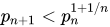
The conjecture states that (where is the -th prime) is a strictly decreasing function of ; i.e.,
![{\displaystyle {\sqrt[{n}]{p_{n}}}}](https://wikimedia.org/api/rest_v1/media/math/render/svg/0688c588c3a609e3131071f8587850ed538f85ec)


![{\displaystyle {\sqrt[{n+1}]{p_{n+1}}}<{\sqrt[{n}]{p_{n}}}}](https://wikimedia.org/api/rest_v1/media/math/render/svg/501a231e852905451b0b802310ec496fb71aed17)
for all . Equivalently, . See OEIS: A182134, OEIS: A246782.

By using a table of maximal gaps, Firoozbakht verified her conjecture up to .[2] Now with more extensive tables of maximal gaps, the conjecture has been verified for all primes below .[3][4][5]


If the conjecture were true, then the prime gap function would satisfy[6]


for all , and[7]


for all . See also OEIS: A111943. This is among the strongest upper bounds conjectured for prime gaps, even somewhat stronger than the Cramér and Shanks conjectures.[4] It implies a strong form of Cramér's conjecture and is hence inconsistent with the heuristics of Granville and Pintz[8][9][10] and of Maier,[11][12] which suggest that


occurs infinitely often for any where denotes the Euler–Mascheroni constant.


Three related conjectures (see the comments of OEIS: A182514) are variants of Firoozbakht's. Forgues notes that Firoozbakht's can be written

where the right hand side is the well-known expression which reaches Euler's number in the limit , suggesting the slightly weaker conjecture


Nicholson and Farhadian[13][14] give two stronger versions of Firoozbakht's conjecture which can be summarized as:

where the right-hand inequality is Firoozbakht's, the middle is Nicholson's (since ; see the article on non-asymptotic bounds on the prime-counting function) and the left-hand inequality is Farhadian's (since ; see prime-counting function § inequalities.


All have been verified to 264.[5]
See also
Notes
- ↑ Ribenboim, Paulo (2004). The Little Book of Bigger Primes (Second ed.). Springer-Verlag. p. 185. ISBN 978-0-387-20169-6.
- 1 2 Rivera, Carlos. "Conjecture 30. The Firoozbakht Conjecture". Retrieved 22 August 2012.
- ↑ Oliveira e Silva, Tomás (December 30, 2015). "Gaps between consecutive primes". Retrieved 2024-11-01.
- 1 2 Kourbatov, Alexei. "Prime Gaps: Firoozbakht Conjecture".
- 1 2 Visser, Matt (August 2019). "Verifying the Firoozbakht, Nicholson, and Farhadian conjectures up to the 81st maximal prime gap". Mathematics. 7 (8) 691. arXiv:1904.00499. doi:10.3390/math7080691.
- ↑ Sinha, Nilotpal Kanti (2010), "On a new property of primes that leads to a generalization of Cramer's conjecture", arXiv:1010.1399 [math.NT].
- ↑ Kourbatov, Alexei (2015), "Upper bounds for prime gaps related to Firoozbakht's conjecture", Journal of Integer Sequences, 18 (Article 15.11.2), arXiv:1506.03042, MR 3436186, Zbl 1390.11105.
- ↑ Granville, A. (1995), "Harald Cramér and the distribution of prime numbers" (PDF), Scandinavian Actuarial Journal, 1: 12–28, doi:10.1080/03461238.1995.10413946, MR 1349149, Zbl 0833.01018, archived from the original (PDF) on 2016-05-02.
- ↑ Granville, Andrew (1995), "Unexpected irregularities in the distribution of prime numbers" (PDF), Proceedings of the International Congress of Mathematicians, vol. 1, pp. 388–399, doi:10.1007/978-3-0348-9078-6_32, ISBN 978-3-0348-9897-3, Zbl 0843.11043.
- ↑ Pintz, János (2007), "Cramér vs. Cramér: On Cramér's probabilistic model for primes", Funct. Approx. Comment. Math., 37 (2): 232–471, doi:10.7169/facm/1229619660, MR 2363833, S2CID 120236707, Zbl 1226.11096
- ↑ Adleman, Leonard M.; McCurley, Kevin S. (1994), "Open problems in number-theoretic complexity. II", in Adleman, Leonard M.; Huang, Ming-Deh (eds.), Algorithmic Number Theory: Proceedings of the First International Symposium (ANTS-I) held at Cornell University, Ithaca, New York, May 6–9, 1994, Lecture Notes in Computer Science, vol. 877, Berlin: Springer, pp. 291–322, doi:10.1007/3-540-58691-1_70, ISBN 3-540-58691-1, MR 1322733
- ↑ Maier, Helmut (1985), "Primes in short intervals", The Michigan Mathematical Journal, 32 (2): 221–225, doi:10.1307/mmj/1029003189, ISSN 0026-2285, MR 0783576, Zbl 0569.10023
- ↑ n</sub>^(P<sub>n+1</sub>/P<sub>n</sub>)^n<=n^P<sub>n</sub>"},"year":{"wt":"2016"},"website":{"wt":"PrimePuzzles.net"},"url":{"wt":"https://www.primepuzzles.net/conjectures/conj_078.htm"},"access-date":{"wt":"2024-11-01"}},"i":0}}]}' id="mwAWI"/>Rivera, Carlos (2016). "Conjecture 78: Pn^(Pn+1/Pn)^n<=n^Pn". PrimePuzzles.net. Retrieved 2024-11-01.
- ↑ Farhadian, Reza (October 2017). "On a New Inequality Related to Consecutive Primes". Acta Universitatis Danubius. Œconomica. 13 (5): 236–242. Archived from the original on 2018-04-19. Retrieved 2024-11-05.
References
- Ribenboim, Paulo (2004). The Little Book of Bigger Primes (Second ed.). Springer-Verlag. ISBN 0-387-20169-6.
- Riesel, Hans (1985). Prime Numbers and Computer Methods for Factorization (Second ed.). Birkhauser. ISBN 3-7643-3291-3.
