Texto da Wikipédia (en), licença CC BY-SA. O BETARUBI mostra o verbete inteiro nesta página — a leitura não continua fora do site.
Generalization in fractional calculus
In mathematics, the Caputo fractional derivative, also called Caputo-type fractional derivative, is a generalization of derivatives for non-integer orders named after Michele Caputo. Caputo first defined this form of fractional derivative in 1967.[1]
Motivation
The Caputo fractional derivative is motivated from the Riemann–Liouville fractional integral. Let  be continuous on
  , then the Riemann–Liouville fractional integral
  states that
![{\displaystyle {_{0}^{\text{RL}}\operatorname {I} _{x}^{\alpha }}\left[f\left(x\right)\right]={\frac {1}{\Gamma \left(\alpha \right)}}\cdot \int \limits _{0}^{x}{\frac {f\left(t\right)}{\left(x-t\right)^{1-\alpha }}}\,\operatorname {d} t}](https://wikimedia.org/api/rest_v1/media/math/render/svg/32b2c4d2a0458a53deedd31fd6e42ddd163c8674)
where  is the Gamma function.
Let's define  , say that
 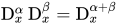 and that
  applies. If
  then we could say
  . So if
  is also
  , then
![{\displaystyle {\operatorname {D} _{x}^{m+z}}\left[f\left(x\right)\right]={\frac {1}{\Gamma \left(1-z\right)}}\cdot \int \limits _{0}^{x}{\frac {f^{\left(1+m\right)}\left(t\right)}{\left(x-t\right)^{z}}}\,\operatorname {d} t.}](https://wikimedia.org/api/rest_v1/media/math/render/svg/a081af9954ae43d6839b0cc4da29bb9c3d2a3f4f)
This is known as the Caputo-type fractional derivative, often written as  .
.
Definition
The first definition of the Caputo-type fractional derivative was given by Caputo as:
![{\displaystyle {^{\text{C}}\operatorname {D} _{x}^{m+z}}\left[f\left(x\right)\right]={\frac {1}{\Gamma \left(1-z\right)}}\cdot \int \limits _{0}^{x}{\frac {f^{\left(m+1\right)}\left(t\right)}{\left(x-t\right)^{z}}}\,\operatorname {d} t}](https://wikimedia.org/api/rest_v1/media/math/render/svg/138f94697ffd5b346e2e43660224e77b9de1cae9)
where and  .[2]
.[2]
A popular equivalent definition is:
![{\displaystyle {^{\text{C}}\operatorname {D} _{x}^{\alpha }}\left[f\left(x\right)\right]={\frac {1}{\Gamma \left(\left\lceil \alpha \right\rceil -\alpha \right)}}\cdot \int \limits _{0}^{x}{\frac {f^{\left(\left\lceil \alpha \right\rceil \right)}\left(t\right)}{\left(x-t\right)^{\alpha +1-\left\lceil \alpha \right\rceil }}}\,\operatorname {d} t}](https://wikimedia.org/api/rest_v1/media/math/render/svg/71777eade0c4722f4bacae90571d8da69bc512f7)
where  and
and  is the ceiling function. This can be derived by substituting
  so that
 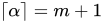 would apply and
  follows.[3]
Another popular equivalent definition is given by:
![{\displaystyle {^{\text{C}}\operatorname {D} _{x}^{\alpha }}\left[f\left(x\right)\right]={\frac {1}{\Gamma \left(n-\alpha \right)}}\cdot \int \limits _{0}^{x}{\frac {f^{\left(n\right)}\left(t\right)}{\left(x-t\right)^{\alpha +1-n}}}\,\operatorname {d} t}](https://wikimedia.org/api/rest_v1/media/math/render/svg/a1ec7714bac06791e632ef971e979fc84c02bc2f)
where  .
.
The problem with these definitions is that they only allow arguments in  . This can be fixed by replacing the lower integral limit with
  :
: ![{\textstyle {_{a}^{\text{C}}\operatorname {D} _{x}^{\alpha }}\left[f\left(x\right)\right]={\frac {1}{\Gamma \left(\left\lceil \alpha \right\rceil -\alpha \right)}}\cdot \int \limits _{a}^{x}{\frac {f^{\left(\left\lceil \alpha \right\rceil \right)}\left(t\right)}{\left(x-t\right)^{\alpha +1-\left\lceil \alpha \right\rceil }}}\,\operatorname {d} t}](https://wikimedia.org/api/rest_v1/media/math/render/svg/b5535c35870b70feb48a7ac931d6c4e88b7be5c6) . The new domain is
. The new domain is  .[4]
.[4]
Properties and theorems
Relation to other fractional differential operators
Caputo-type fractional derivative is closely related to the Riemann–Liouville fractional integral via its definition:
![{\displaystyle {_{a}^{\text{C}}\operatorname {D} _{x}^{\alpha }}\left[f\left(x\right)\right]={_{a}^{\text{RL}}\operatorname {I} _{x}^{\left\lceil \alpha \right\rceil -\alpha }}\left[\operatorname {D} _{x}^{\left\lceil \alpha \right\rceil }\left[f\left(x\right)\right]\right]}](https://wikimedia.org/api/rest_v1/media/math/render/svg/31b0212b2f9973ffc903eb596d075cd1fdb2397c)
Furthermore, the following relation applies:
![{\displaystyle {_{a}^{\text{C}}\operatorname {D} _{x}^{\alpha }}\left[f\left(x\right)\right]={_{a}^{\text{RL}}\operatorname {D} _{x}^{\alpha }}\left[f\left(x\right)\right]-\sum \limits _{k=0}^{\left\lfloor \alpha \right\rfloor }\left[{\frac {x^{k-\alpha }}{\Gamma \left(k-\alpha +1\right)}}\cdot f^{\left(k\right)}\left(0\right)\right]}](https://wikimedia.org/api/rest_v1/media/math/render/svg/135959b3ffc6a242b4d95b8cf970f756adf0af9f)
where  is the Riemann–Liouville fractional derivative.
The Laplace transform of the Caputo-type fractional derivative is given by:
![{\displaystyle {\mathcal {L}}_{x}\left\{{_{a}^{\text{C}}\operatorname {D} _{x}^{\alpha }}\left[f\left(x\right)\right]\right\}\left(s\right)=s^{\alpha }\cdot F\left(s\right)-\sum \limits _{k=0}^{\left\lceil \alpha \right\rceil -1}\left[s^{\alpha -k-1}\cdot f^{\left(k\right)}\left(0\right)\right]}](https://wikimedia.org/api/rest_v1/media/math/render/svg/0e9932da6197a1383c7e866a9cc52cdf6116ac67)
where  .[8]
.[8]
Caputo fractional derivative of some functions
The Caputo fractional derivative of a constant  is given by:
![{\displaystyle {\begin{aligned}{_{a}^{\text{C}}\operatorname {D} _{x}^{\alpha }}\left[c\right]&={\frac {1}{\Gamma \left(\left\lceil \alpha \right\rceil -\alpha \right)}}\cdot \int \limits _{a}^{x}{\frac {\operatorname {D} _{t}^{\left\lceil \alpha \right\rceil }\left[c\right]}{\left(x-t\right)^{\alpha +1-\left\lceil \alpha \right\rceil }}}\,\operatorname {d} t={\frac {1}{\Gamma \left(\left\lceil \alpha \right\rceil -\alpha \right)}}\cdot \int \limits _{a}^{x}{\frac {0}{\left(x-t\right)^{\alpha +1-\left\lceil \alpha \right\rceil }}}\,\operatorname {d} t\\{_{a}^{\text{C}}\operatorname {D} _{x}^{\alpha }}\left[c\right]&=0\end{aligned}}}](https://wikimedia.org/api/rest_v1/media/math/render/svg/01dd0bb475bc01fa68ee24b5a24b635b2580b0a6)
The Caputo fractional derivative of a power function  is given by:[9]
![{\displaystyle {\begin{aligned}{_{a}^{\text{C}}\operatorname {D} _{x}^{\alpha }}\left[x^{b}\right]&={_{a}^{\text{RL}}\operatorname {I} _{x}^{\left\lceil \alpha \right\rceil -\alpha }}\left[\operatorname {D} _{x}^{\left\lceil \alpha \right\rceil }\left[x^{b}\right]\right]={\frac {\Gamma \left(b+1\right)}{\Gamma \left(b-\left\lceil \alpha \right\rceil +1\right)}}\cdot {_{a}^{\text{RL}}\operatorname {I} _{x}^{\left\lceil \alpha \right\rceil -\alpha }}\left[x^{b-\left\lceil \alpha \right\rceil }\right]\\{_{a}^{\text{C}}\operatorname {D} _{x}^{\alpha }}\left[x^{b}\right]&={\begin{cases}{\frac {\Gamma \left(b+1\right)}{\Gamma \left(b-\alpha +1\right)}}\left(x^{b-\alpha }-a^{b-\alpha }\right),\,&{\text{for }}\left\lceil \alpha \right\rceil -1<b\wedge b\in \mathbb {R} \\0,\,&{\text{for }}\left\lceil \alpha \right\rceil -1\geq b\wedge b\in \mathbb {N} \\\end{cases}}\end{aligned}}}](https://wikimedia.org/api/rest_v1/media/math/render/svg/7f9f9d9bfc07939992110d7c4a38b85ff0f408ea)
The Caputo fractional derivative of an exponential function  is given by:
![{\displaystyle {\begin{aligned}{_{a}^{\text{C}}\operatorname {D} _{x}^{\alpha }}\left[e^{b\cdot x}\right]&={_{a}^{\text{RL}}\operatorname {I} _{x}^{\left\lceil \alpha \right\rceil -\alpha }}\left[\operatorname {D} _{x}^{\left\lceil \alpha \right\rceil }\left[e^{b\cdot x}\right]\right]=b^{\left\lceil \alpha \right\rceil }\cdot {_{a}^{\text{RL}}\operatorname {I} _{x}^{\left\lceil \alpha \right\rceil -\alpha }}\left[e^{b\cdot x}\right]\\{_{a}^{\text{C}}\operatorname {D} _{x}^{\alpha }}\left[e^{b\cdot x}\right]&=b^{\alpha }\cdot \left(E_{x}\left(\left\lceil \alpha \right\rceil -\alpha ,\,b\right)-E_{a}\left(\left\lceil \alpha \right\rceil -\alpha ,\,b\right)\right)\\\end{aligned}}}](https://wikimedia.org/api/rest_v1/media/math/render/svg/2b7d8409f8544e0b3f07907a4973db9ec168071e)
where  is the
  -function and
  is the lower incomplete gamma function.[10]
References
- ↑ Diethelm, Kai (2019). "General theory of Caputo-type fractional differential equations". Fractional Differential Equations. pp. 1–20. doi:10.1515/9783110571660-001. ISBN 978-3-11-057166-0. Retrieved 2023-08-10.
- ↑ Caputo, Michele (1967). "Linear Models of Dissipation whose Q is almost Frequency Independent-II". ResearchGate. 13 (5): 530. Bibcode:1967GeoJ...13..529C. doi:10.1111/j.1365-246X.1967.tb02303.x.
- ↑ Lazarević, Mihailo; Rapaić, Milan Rade; Šekara, Tomislav (2014). "Introduction to Fractional Calculus with Brief Historical Background". ResearchGate: 8.
- ↑ Dimitrov, Yuri; Georgiev, Slavi; Todorov, Venelin (2023). "Approximation of Caputo Fractional Derivative and Numerical Solutions of Fractional Differential Equations". Fractal and Fractional. 7 (10): 750. doi:10.3390/fractalfract7100750.
- ↑ Sikora, Beata (2023). "Remarks on the Caputo fractional derivative" (PDF). Matematyka I Informatyka Na Uczelniach Technicznych (5): 78–79.
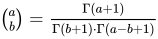
- ↑ Huseynov, Ismail; Ahmadova, Arzu; Mahmudov, Nazim (2020). "Fractional Leibniz integral rules for Riemann-Liouville and Caputo fractional derivatives and their applications". ResearchGate: 1. arXiv:2012.11360.
- ↑ Weisstein, Eric W. (2024). "Binomial Coefficient". mathworld.wolfram.com. Retrieved 2024-05-20.
- ↑ Sontakke, Bhausaheb Rajba; Shaikh, Amjad (2015). "Properties of Caputo Operator and Its Applications to Linear Fractional Differential Equations" (PDF). Journal of Engineering Research and Applications. 5 (5): 23–24. ISSN 2248-9622.
- ↑ Weisstein, Eric W. "Fractional Derivative". mathworld.wolfram.com. Retrieved 2024-05-20.
- ↑ Weisstein, Eric W. (2024). "E_t-Function". mathworld.wolfram.com. Retrieved 2024-05-20.


![{\displaystyle {_{a}^{\text{C}}\operatorname {D} _{x}^{\alpha }}\left[f\left(x\right)\right]}](https://wikimedia.org/api/rest_v1/media/math/render/svg/cd8cacbd2e730ad68dbad7868e4f7e5a11f5d19c)


![{\displaystyle b\cdot {_{a}^{\text{C}}\operatorname {D} _{x}^{\alpha }}\left[g\left(x\right)\right]+c\cdot {_{a}^{\text{C}}\operatorname {D} _{x}^{\alpha }}\left[h\left(x\right)\right]}](https://wikimedia.org/api/rest_v1/media/math/render/svg/c067167108b7a82c81284037102d8791b575b06f)




![{\displaystyle \operatorname {_{a}^{\text{C}}D} _{x}^{\alpha }\left[g\left(x\right)\cdot h\left(x\right)\right]=\sum \limits _{k=0}^{\infty }\left[{\binom {a}{k}}\cdot g^{\left(k\right)}\left(x\right)\cdot \operatorname {_{a}^{\text{RL}}D} _{x}^{\alpha -k}\left[h\left(x\right)\right]\right]-{\frac {\left(x-a\right)^{-\alpha }}{\Gamma \left(1-\alpha \right)}}\cdot g\left(a\right)\cdot h\left(a\right)}](https://wikimedia.org/api/rest_v1/media/math/render/svg/12bf52380a489942d650c30cd48f0fa02cb0f60d)